Brick Blast - Brick Breaker
- 4.8
- Rating
- 5.00M
- Installs
- Free
- Price
 Analysis by App-foxy
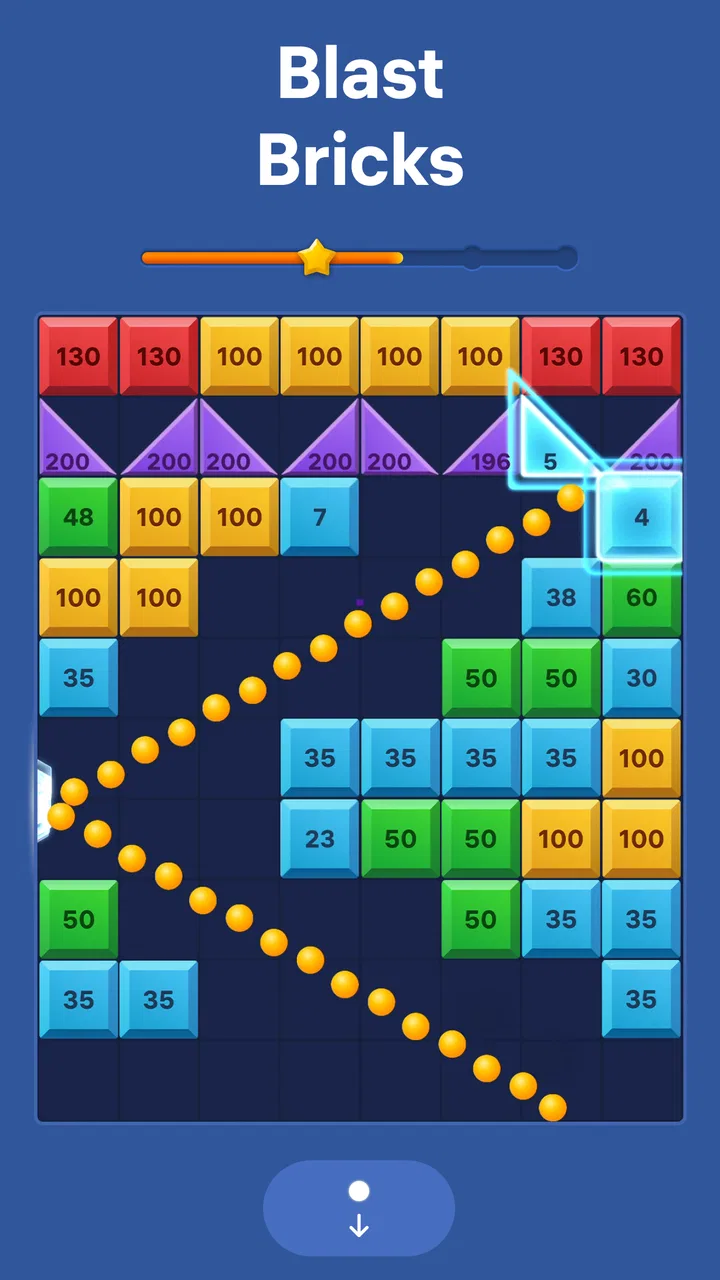
I spent time with Brick Blast - Ball Breaker as a quick puzzle game built around a simple loop: aim balls, break numbered bricks, and try to clear the board before the arrangement becomes unmanageable. That basic idea is familiar, but the appeal here is how little preparation it needs. I can pick it up for a short break, understand the current challenge immediately, and put it down without having to remember a complicated story or a long list of controls.
It comes from Easybrain, a developer already associated with accessible puzzle experiences, and it sits firmly in the casual end of the puzzle category. The game is free to install, which makes trying it a low-risk decision. It has reached over a million installs and holds a 4.7 average from around twenty-seven thousand ratings, so there is clear interest in this particular take on brick breaking. My experience was positive overall, although the simplicity that makes it approachable also limits how deep it feels after extended sessions.
How the free game creates value
The most important cost detail is straightforward: the core download is free. That matters because this is the sort of game I would normally use in small, unpredictable moments rather than plan a paid gaming session around. I can test the controls, see whether the pace suits me, and decide whether it deserves a regular place on my phone without paying first.
You May Also Like

 Blood Strike: 2.5 Anniversary
Blood Strike’s Loadouts Turn Every Drop Into a Tactical Gamble
A close look at Blood Strike’s custom loadouts: how fast access to signature weapons reshapes its battle royale rhythm, rewards preparation, and narrows the gap between fights.

 Pandora - Music & Podcasts
Pandora’s Music Is Easy to Start, but Harder to Recover
Pandora’s strength is its low-effort path from a seed to a station. Its weak spot is how much confidence it asks you to place in connection, setup, and quiet recovery.

 8 Ball Pool
 Is Built on Rivalries, Rematches, and Routine
A close look at the rivalries, rematches, shared routines, and unanswered safety questions that turn a quick pool match into a persistent mobile community.

 Samsung Music
’s Quiet Strength Is Playing What You Already Own
Its reach comes less from spectacle than from dependable access to a personal library. That simplicity is both the app’s strongest retention engine and its ceiling.

 AccuWeather: Weather Radar
AccuWeather Review: A Quick, Clear Forecast for Everyday Decisions
For everyday plans, the best forecast is the one you can understand quickly. AccuWeather makes rain timing, radar, and local conditions easy to act on, with a few trade-offs.

 Hill Climb Racing
Why Hill Climb Racing Still Turns Crashes Into One More Run
A tiny car, a bumpy hill and one more upgrade: Hill Climb Racing keeps resurfacing because its simple chaos makes every near-miss feel personal.
More From Our News Desk



There are in-app purchases priced at $14.99 per item. I would treat those as an optional spending decision rather than part of the basic entry cost. The free access is enough to judge the central brick-breaking loop, while the purchase price is significant enough that I would not buy anything impulsively. Anyone considering a purchase should first decide whether the game is providing lasting value in their own routine, rather than assuming that spending will automatically make the puzzles more satisfying.
This distinction is useful: free access makes experimentation affordable, but the paid value depends on how often you return. If I only want a few minutes of distraction now and then, the free version may already do what I need. If I expect a long-term puzzle habit, I would spend time with the free experience before deciding whether an individual item is worth the cost.
The game is marked for Teen audiences, and it runs on Android 7.0 or later. That gives it a reasonably broad device range, especially for people using older Android phones, though compatibility is still something I would check before installing on a particularly old or unusual handset. The current version is 1.4.0, so keeping the app updated is sensible when possible, both for access to the current build and for a smoother experience.
The moment-to-moment loop is easy to learn
The first strength is clarity. Brick Blast - Ball Breaker does not ask me to learn a complicated control scheme before I can enjoy it. The essential decision is where to send the shot so that the balls hit useful targets and continue doing work around the board. That makes the game suitable for a short commute, a waiting room, or the few minutes before an appointment begins.
The apparent simplicity hides a small amount of planning. A direct hit is not always the best hit. I get more value from considering the angle, looking for opportunities to let a ball travel through several bricks, and thinking about which parts of the board will become troublesome later. The best move is often the one that creates a better next position rather than the one that removes the largest visible brick immediately.
That is one of the more useful insights for new players: do not judge a shot only by its first impact. A shallow angle can sometimes keep the ball active across a wider area, while a careless angle may return it quickly and leave the most dangerous section untouched. I found that taking an extra moment to inspect the full path was more productive than firing as soon as the target appeared.
Another practical habit is to watch the lower part of the board before committing. Clearing a high brick can feel rewarding, but preserving room for future shots is often more important. When the board begins to fill, a technically strong shot can still be a poor choice if it leaves an awkward cluster near the bottom. This gives the game a light strategic layer without turning it into a demanding planning exercise.
Why short sessions suit it best
I think the strongest use case is a series of brief sessions. The game is easy to start, and its familiar structure means I do not need a tutorial refresher every time I return. It works well when I want something more interactive than scrolling but less demanding than a traditional strategy game.
For example, I could open it while waiting for a coffee, play a few rounds, and close it when my order is ready. The game does not require me to create a large block of free time in advance. That makes it a better fit for fragmented days than puzzle games that depend on lengthy levels, narrative continuity, or a carefully prepared setup.
It can also work as a low-pressure mental reset. Aiming requires enough attention to interrupt a dull moment, but the rules are familiar enough that I am not spending the whole session learning systems. I would not call it a replacement for a deep logic puzzle, though. Its satisfaction comes from improving a shot and managing the board, not from solving a complex mystery or building a detailed strategy over many hours.
Where it differs from other puzzle choices
Compared with a traditional match-three game, this one puts more emphasis on trajectory and timing of decisions than on scanning for color combinations. That difference is important if I enjoy spatial judgment but find match-three boards repetitive. On the other hand, players who prefer creating cascades, collecting themed pieces, or following a story may find the brick-breaking format less varied.
Compared with a classic arcade brick breaker, the puzzle framing makes each shot feel more deliberate. I am not simply reacting to a bouncing ball in real time; I am choosing a path and considering the board’s future shape. That makes it calmer than reflex-heavy arcade alternatives, although it may feel less exciting to someone who wants constant movement and immediate action.
It also differs from serious logic apps that offer carefully structured deduction challenges. Those games usually reward a correct solution to a defined problem. Brick Blast - Ball Breaker is more about repeated tactical choices, board control, and making the most of a shot. I would choose it for quick replayable entertainment, not for a rigorous brain-training routine.
Tradeoffs that become clearer with regular play
The main limitation is that the central idea can become familiar quickly. Aiming balls at bricks is satisfying when I am in the mood for a compact challenge, but it does not offer the same variety as a puzzle game with several distinct modes or mechanics. After repeated sessions, I may start to want a stronger sense of progression or a broader set of problems.
That does not make the game poor; it simply defines its audience. Its value comes from accessibility and repeatable short play rather than from a large amount of content that I can analyze for weeks. If I want a game to become a major hobby, I would look for something more substantial. If I want a dependable time filler, the limited scope is easier to accept.
The free-to-try model is another tradeoff. It is convenient because I can start without an upfront payment, but the presence of individual purchases means I should keep an eye on my own spending habits. I would not recommend buying an item merely because I had a particularly good round or wanted to remove a momentary frustration. The sensible approach is to use the free experience first and only consider spending when the benefit is clear in my own routine.
There is also a difference between being easy to learn and being easy to master. The controls are approachable, but good results still depend on reading angles and anticipating the board’s next state. New players may initially fire too quickly or focus on one brick instead of the overall layout. The game rewards patience, but it does not always announce why a shot was weak, so improvement comes from observing the consequences of each decision.
My most useful adjustment was to stop treating every turn as an isolated opportunity. Before shooting, I look at the likely return path, the remaining open spaces, and whether the first collision will actually improve the board. This turns the experience from random tapping into a small planning exercise. It is a modest insight, but it makes the game feel more intentional and helps prevent avoidable board congestion.
Who will get the most from it
I would recommend it to someone who wants a free casual puzzle game that starts quickly and uses a familiar concept in a more thoughtful way than pure reflex play. It is especially suitable for players who enjoy aiming, testing angles, and making incremental improvements without committing to a long campaign.
It is also a good match for people who prefer games that can be played in short bursts. The low learning barrier makes it easy to share with a family member or friend who does not normally play mobile games, although the Teen content rating should still guide household decisions. The broad Android requirement is helpful for users who are not carrying a new device.
I would be more cautious about recommending it to someone who needs a deep puzzle system, a strong narrative, or a large variety of modes. Players who dislike repeating a central mechanic may lose interest once the novelty fades. Likewise, anyone looking for a fast arcade experience may prefer a traditional brick breaker with more immediate reflex pressure.
It is not the right choice if my main goal is to avoid all optional spending prompts or if I know that free-to-play purchases make me uncomfortable. The download itself is free, but the presence of $14.99 items means I would want to use the platform’s purchase controls responsibly. For me, that is manageable, but it is still part of the decision.
Practical ways to play more effectively
My first tip is to prioritize board shape over the most attractive target. A large brick may look like the obvious choice, but opening a useful lane can create more opportunities on later turns. I try to identify which impact point gives the ball the longest productive route while preserving space at the bottom.
My second tip is to use the preview period for planning rather than rushing. Even in a simple game, the strongest move may take a few seconds to see. I check whether the shot will bounce into a crowded area, whether it can reach several bricks, and whether the return path leaves enough room for the next turn.
My third tip is to treat difficult rounds as information rather than just failure. If a board collapses after a particular type of angle, I can adjust the next attempt by opening a different lane earlier. This mindset makes the game less frustrating because each round teaches me something about spacing and trajectory.
A fourth useful approach is to separate casual play from purchase decisions. I would play when I want the puzzle itself, not when I am trying to justify an expense. If the free version already provides enough entertainment, there is no reason to spend simply because an optional item is available. That keeps the game’s value tied to enjoyment rather than impulse.
My verdict on whether it is worth installing
After using it, I see Brick Blast - Ball Breaker as a focused, approachable puzzle game rather than a complete all-purpose gaming destination. Its strongest qualities are the quick start, understandable objective, and small amount of tactical thinking created by ball paths and board management. Easybrain has chosen a format that is easy to explain but still gives careful players room to improve their decisions.
The free download makes it easy for me to recommend trying. I would install it if I wanted a casual game for short breaks, especially if I enjoyed the idea of combining brick breaking with deliberate aiming. The 4.7 average and over a million installs suggest that the format has connected with many players, while the current 1.4.0 release gives new users a clear version to look for.
My recommendation becomes more limited if I am searching for long-term depth. The repeating core can feel narrow beside puzzle games with multiple systems, richer progression, or more varied challenges. I would also approach the paid items carefully because one item costs $14.99, which is not a trivial amount for a game I may use only occasionally.
In the end, I would keep it installed as a convenient free time-filler, not as my only puzzle game. It delivers enough value without requiring an upfront payment, and the aiming decisions make it more engaging than mindless tapping. If you want a clean, short-session brick puzzle and are comfortable treating purchases as optional, it is worth trying; if you need deep variety or a fully paid, distraction-free experience, I would skip it in favor of a different puzzle style.
FAQs for Brick Blast - Brick Breaker
01What is the main objective of Brick Blast - Ball Breaker?
Brick Blast - Ball Breaker is a classic arcade-style game where the main objective is to break all the bricks on the screen by strategically aiming and launching balls. Players must use precise angles and clever tactics to clear each level and advance through increasingly challenging stages.
02How do the power-ups work in Brick Blast - Ball Breaker?
In Brick Blast - Ball Breaker, power-ups play a crucial role in enhancing gameplay. They can be collected by hitting specific bricks and provide benefits like additional balls, extra turns, or powerful shots. Understanding how to effectively utilize these power-ups can significantly improve your chances of success.
03Is Brick Blast - Ball Breaker free to play?
Yes, Brick Blast - Ball Breaker is free to download and play on both Android and iOS platforms. However, the game may offer in-app purchases for additional features, such as extra power-ups or level packs, which can enhance the gaming experience but are not necessary to enjoy the core game.
04Can I play Brick Blast - Ball Breaker offline?
Brick Blast - Ball Breaker can be played offline, allowing you to enjoy the game without an internet connection. This makes it a perfect choice for playing on the go or in situations where Wi-Fi or mobile data is unavailable. However, certain features, like in-app purchases, will require an internet connection.
05Are there any ads in Brick Blast - Ball Breaker?
Brick Blast - Ball Breaker includes advertisements, which may appear between levels or when accessing certain features. While ads can be a minor inconvenience, they support the free-to-play model. Players may have the option to remove ads through an in-app purchase if they prefer an uninterrupted gaming experience.
Pros
- Smooth and responsive controls enhance gameplay.
- Variety of levels keeps the game engaging.
- Offline play available for on-the-go fun.
- Vibrant graphics make it visually appealing.
- Easy to learn with a simple interface.
Cons
- Ads can be intrusive during gameplay.
- In-app purchases may be pricey.
- Limited power-ups without purchases.
- Repetitive music can become annoying.
- Difficulty spike in later levels.

Brick Blast - Brick Breaker
Gallery